Saturday, March 03, 2012

The Awards and the Dresses


Oh, Oscar. You broke my heart.

I have watched 19 Oscar telecasts, and only twice has an outcome been so unexpected and upsetting that I screamed, stared in bewilderment, and sulked the rest of the evening. The first, of course, was when Crash stole Best Picture from Brokeback Mountain. The second was on Sunday, when Viola Davis somehow lost so that Meryl Streep could have a third win.


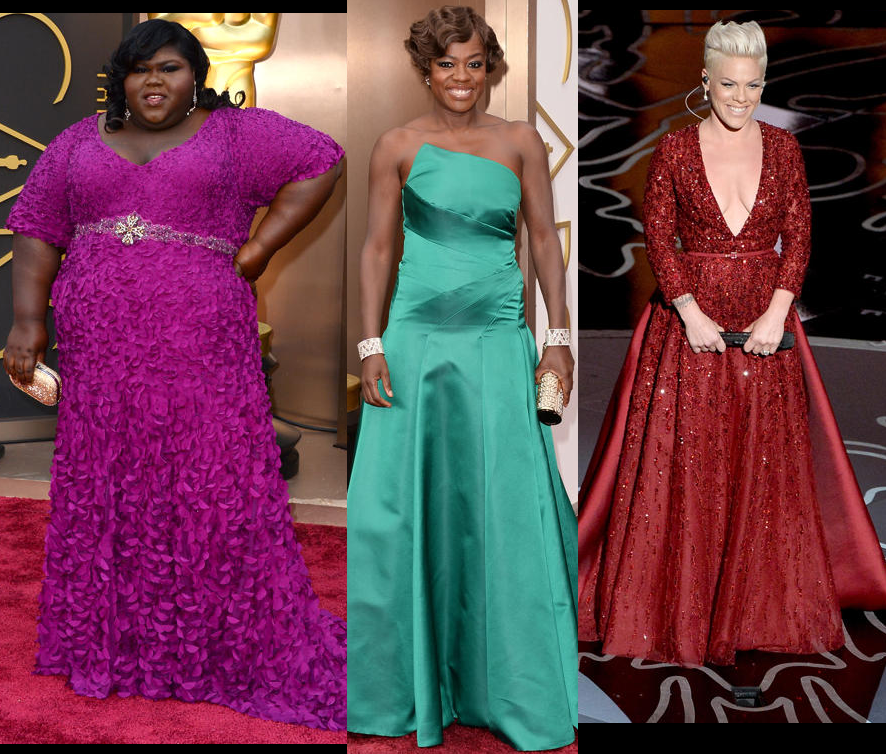
Here is a picture of Ms. Spencer and Ms. Davis on the red carpet at the Oscars, beside a picture of their deserved wins at the SAG awards. Now just imagine those statuettes are gold instead of turquoise, and have a sword covering their junk... (Sigh...)


It wasn't all a bummer, because the other wins I was hoping for most came true. Stars of awesomely weird television comedy -- Jim Rash of Community and Bret McKenzie of Flight of the Conchords -- were the victors for Best Adapted Screenplay and Best Song, respectively.

Onto the pretty dresses!


The Best Actress lineup looks pretty darn good. Glenn Close's choice of a blazered dress (representing her cross-dressing performance) was a little cutesy, but feminine neckline and lush forest green color were quite flattering. Viola Davis wore the most gorgeous shade of green, and her gown mixed up textures without looking messy. Rooney Mara's dress was a bit flimsy and dull. Meryl Streep looked the most glamorous she has in years, with artfully gathered fabric in Oscar-matching gold. Michelle Williams wore a tangy shade of coral; the ensemble would have been perfect if the clip at her waistline were a more elegant shape.


As for the Supporting Actress nominees, Berenice Bejo did not look her best. I love the mint green color, but between the long heavy sleeves and her tightly pulled back hair, the ensemble worked against her very lovely features. Jessica Chastain looked positively amazing in the exquisitely embroidered black and gold gown, which was wisely accessorized with her flowing, insanely beautiful hair. Melissa McCarthy wore a dreamy shade of peach, though the shape of the dress was on the bulky and messy side. I had to comb the internet for a picture of Janet McTeer, and why? Her tomato-red gown was all va-voom, showing off the, um, womanliness that she somehow managed to hide in Albert Nobbs. Finally, Octavia Spencer was dressed like a winner in sumptuous silver.


Warm pastels flattered Cameron Diaz, Wendi McClendon-Covey, Penelope Ann Miller, and Kristen Wiig.


Hot shades of red were fabulous on Ellie Kemper and Natalie Portman, but Emma Stone's slender neck was overwhelmed by that horrible giant bow.


I have no idea why Bo Derek and Virginia Madsen were invited, but I love their purple gowns. Maya Rudolph didn't come out quite as well in eggplant.


Missy Pyle, Annie Mumolo, Penelope Cruz, Leslie Mann, and Tina Fey make me long for the ocean.


Earrings I would happily steal: the emeralds on Berenice Bejo, yellow diamonds on Jessica Chastain, sapphires (?) on Tina Fey, opals (?) on Busy Phillips, pearls on Rose Byrne, and amber (?) on Ellie Kemper.


Only two men wore anything worth mentioning. Christopher Plummer is the very definition of classy in a blue velvet tux, and Sacha Baron Cohen is the gleeful opposite in ridiculous costume. Thanks for mixing it up, fellas!

Friday, February 24, 2012

Best Actor


Demian Bichir, A Better Life
George Clooney, The Descendants
Jean Dujardin, The Artist
Gary Oldman, Tinker Tailor Soldier Spy
Brad Pitt, Moneyball

George vs. Brad got a last-minute dash of Jean!

Pitt could still win; he’s the star of two Best Picture nominees, as well as many of Oscar’s favorites in recent years (Inglourious Basterds, Benjamin Button, Assassination of Jesse James, Babel). I’m demoting him to third-most-likely because while his performance in Moneyball is absolutely solid, it’s just not dramatic enough to knock out the competition.

Non-English-speaking foreigners are always a tougher sell for the big awards, because we may never see them in a stateside film again. America fell in love with Roberto Benigni 13 years ago, and that Oscar “investment” didn’t pay off very well. (Marion Cotillard, on the other hand, looks like she will be delighting American audiences for years to come.) Dujardin stole the SAG award, and kept his momentum going with self-spoofing appearances on Saturday Night Live and Funny or Die. He could overcome the Academy’s usual prejudice against comedy because of the level-of-difficulty factor: He gave a winningly effective performance without the aid of any dialogue or sound, and his character’s performances in the film-within-a-film were spot-on-impressions of the silent acting style.

I still think Clooney will prevail. This role showcases the best of his dramatic and comedic abilities, and he was mesmerizing whether his scene partners were adults, children, a comatose person, or just the impossibly beautiful scenery. The Artist and The Descendants are going to split the major awards, so score this point for the Hawaiians.

Prediction: George Clooney. Personal Pick: I didn’t see A Better Life, and TTSS is far from Gary Oldman’s most interesting work; I’m good with any of the other three. Though if Clooney is upgraded to a Best Actor winner, it makes it all the more frustrating that the 2005 Supporting Actor award didn’t go to Paul Giamatti!

Best Actress


Glenn Close, Albert Nobbs
Viola Davis, The Help
Rooney Mara, The Girl With the Dragon Tattoo
Meryl Streep, The Iron Lady
Michelle Williams, My Week With Marilyn

First of all, what a kick-ass line-up! The lack of quality starring roles for women often leads to a dud or two in this category, but all five of these performances are exceptional.

Mara is the only one who definitely won’t win. She’s too new, and as with the Lord of the Rings trilogy, Oscar may wait until the third installment to bestow their crown. Williams is definitely going to win before this decade is over, but this year she is overshadowed by the veterans.

Close could squeak in because it’s her sixth nomination and still no wins, though with her introverted character and small-scale film, it’s certainly an uphill battle. Some argue that Streep should win her third statuette because it’s “been awhile” since her last. Ridiculous. She was typically awesome, but her film was not well-received.

True, The Help has inspired many complaints: Some white characters are let off the hook too easily, while other white characters get too much credit for the black characters’ struggles. The film will be honored, though, for the piece it got resoundingly right: The weary, lived-in performances of its stars, standing in for generations of African American women who never saw themselves honestly and humanely portrayed on film. Beloved actress Viola Davis will win, everyone will bawl their eyes out, and it will be awesome.

Prediction and Personal Pick: Viola Davis

Best Supporting Actor


Kenneth Branagh, My Week With Marilyn
Jonah Hill, Moneyball
Nick Nolte, Warrior
Christopher Plummer, Beginners
Max von Sydow, Extremely Loud and Incredibly Close

It was nice to see Hill in a “real” movie, but this is the old men’s contest. Branagh, Nolte, and von Sydow all oughta be Oscar-winners by now, but all are hindered by their films: Marilyn is too slight, Warrior too obscure, EL&IC too divisive. It will be an easy victory, then, for the marvelous Christopher Plummer in his equally marvelous film. At 82 years old, he’ll break Jessica Tandy’s record as the oldest winner in any acting category, he’ll get a standing ovation, and your mom will say, “Ohhh, I like him!”

Prediction and Personal Pick: Christopher Plummer (though I didn’t see Warrior)

Best Supporting Actress


Berenice Bejo, The Artist
Jessica Chastain, The Help
Melissa McCarthy, Bridesmaids
Janet McTeer, Albert Nobbs
Octavia Spencer, The Help

It is so rare that a flat-out hilarious performance wins, and McCarthy’s star-making work this year would make worthy company for Marisa Tomei in My Cousin Vinny or Kevin Kline in A Fish Called Wanda. But with The Help dominating the SAG awards (taking both female categories and Best Ensemble), it is clear which cast of women captured the hearts of their peers. We’ll all join McCarthy in applauding her dear friend Octavia Spencer’s deserved victory.

Prediction and Personal Pick: Octavia Spencer

Best Adapted Screenplay


The Descendants: Nat Faxon, Alexander Payne, Jim Rash
Hugo: John Logan
The Ides of March: George Clooney, Grant Heslov, Beau Willimon
Moneyball: Stan Chervin, Aaron Sorkin, Steven Zaillian
Tinker Tailor Soldier Spy: Bridget O'Connor, Peter Straughan

The Best Picture nominees are the only ones that are really in contention. Hugo could take this as a consolation prize for losing the top two awards, and Moneyball’s snappy dialogue could carry it over the finish line, making back-to-back wins for Aaron Sorkin. Still, smart money is on the WGA winner The Descendants to make a repeat winner out of Alexander Payne and first-time winners of Groudlings alums Nat Faxon and Jim Rash. Yes, that is the same Jim Rash who plays Dean Pelton on Community; I cannot WAIT to see him win!

Prediction and Personal Pick: The Descendants.

Best Original Screenplay


The Artist: Michel Hazanavicius
Bridesmaids: Annie Mumolo, Kristen Wiig
Margin Call: J.C. Chandor
Midnight in Paris: Woody Allen
A Separation: Asghar Farhadi

Here is a refreshingly different Oscar race, where the top three contenders are all various shades of comedy. Bridesmaids could upset; the more likely scenario is a face-off between the American in Paris and the Parisian in America. Midnight was a delightful trifle…whenever the gratingly horrible fiancée and her gratingly horrible parents weren’t onscreen. The trio of top-shelf nods for Allen’s latest film is a token of appreciation for his best film in years, but it doesn’t stand up to his two screenplay wins for Annie Hall or Hannah and Her Sisters. Hazanavicious met a most unusual challenge in writing a story with carefully constructed scenes and the occasional title card, so I think he wins on the “original” front.

Prediction: The Artist. Personal Pick: I didn’t see Margin Call or A Separation, and I had mixed feelings about the other three. If I had to pick, my irreverence favors the ladies.

Best Director


The Artist: Michel Hazanavicius
The Descendants: Alexander Payne
Hugo: Martin Scorsese
Midnight in Paris: Woody Allen
The Tree of Life: Terrence Malick

Last year, I was sure voters would split Best Picture and Director, and in this race choose the American auteur over the European unknown, but they still went with Tom Hooper instead of David Fincher in their King’s Speech love-fest. I think such a scenario will play out again, with Scorsese narrowly losing out to the Best Picture heavyweight.

Prediction: The Artist. Personal Pick: Marty, Marty, Marty!

Best Picture


The Artist
The Descendants
Extremely Loud and Incredibly Close
The Help
Hugo
Midnight in Paris
Moneyball
The Tree of Life
War Horse


Oscar's 84 Best Picture winners shall be bookended with silent films.

Prediction: The Artist. Personal Pick:
Dear little Hugo.

The Rest of the Races

Cinematography: Whether evoking Norman Rockwell or the trippiest learning channel footage you’ve ever seen, The Tree of Life, though maddening, was lovely to look at.

Editing: Sure, have another one, The Artist.

Art Direction: The exquisite eye candy of Hugo.

Costume Design: It’s whichever film has the froufiest costumes but isn’t too terrible…so…um…Jane Eyre?

Score: The Artist had the hardest-working score, providing the entire soundscape. Done.

Sound Mixing: It’s whichever film has the most technical nods, so Hugo.

Sound Editing: Repeat, Hugo.

Visual Effects: Andy Serkis = gold. Rise of the Planet of the Apes.

Makeup: The excellent aging of Meryl Streep in The Iron Lady

Song: Flight of the Conchords fans rejoice, it’s a win for Bret McKenzie and The Muppets!


Animated Feature: The last time this category didn’t have a Pixar heavyweight, it went international with Spirited Away. I’m predicting Rango, but the Spanish Chico and Rita just might upset…

Documentary Feature: Paradise Lost 3: Purgatory is the third installment in a documentary trilogy that literally helped exonerate wrongfully convicted prisoners. Can’t beat that!

Foreign Language Film: A Separation is the favorite, but in recent years, the favorite always loses. In Darkness is about the Holocaust, so…

Julie's Own Damn Oscars (or Anti-Oscars), Given By Her, Damnit!

Films of 2011 I Actually Saw:

Albert Nobbs, The Artist, Beginners, Bridesmaids, Carnage, Crazy Stupid Love, The Descendants, Drive, Extremely Loud and Incredibly Close, 50/50, The Girl With the Dragon Tattoo, The Help, Hugo, The Ides of March, The Iron Lady, Meek’s Cutoff, Midnight in Paris, Moneyball, The Muppets, My Week With Marilyn, Tinker Tailor Soldier Spy, Win-Win


Favorite Films:

Hugo, The Descendants, Win-Win, Beginners


Least Favorite Films:

Crazy Stupid Love, Drive, Meek’s Cutoff


Favorite Performances:

Albert Nobbs: Glenn Close, Janet McTeer

Bridesmaids: Melissa McCarthy

The Descendants cast

50/50: Joseph Gordon-Levitt, Seth Rogan, Anjelica Huston

The Help: Viola Davis, Octavia Spencer, Cicely Tyson

Hugo: Asa Butterfield, Chloe Grace Moretz

Win-Win: Paul Giamatti, Amy Ryan


Coolest Female Characters:

Bridesmaids: Megan (Melissa McCarthy)

The Girl With the Dragon Tattoo: Lisbeth (Rooney Mara)

Hugo: Isabelle (Chloe Grace Moretz)


Lamest Female Characters:

The evil bitches: Marisa Tomei in Crazy Stupid Love, Bryce Dallas Howard in The Help, Rachel McAdams and Mimi Kennedy in Midnight in Paris

The hot chicks who [*SPOILER*]: Christina Hendricks in Drive, Evan Rachel Wood in The Ides of March, Svetlana Khodchenkova in Tinker Tailor Soldier Spy


Lamest Female and Male Characters:

Everyone else in Crazy Stupid Love


Best Musical Number:

Everything in The Muppets

Everything in The Artist


Worst Musical Number:

Everything in Drive


Best Screen Saver:

The Tree of Life


Best Dogs:

Hugo (all of them!)

Beginners

The Artist


Thursday, February 23, 2012

Remember the Ladies...(there are a few of them...)

It is part of my annual Oscar tidings to note the female filmmakers who contributed to the nominated films, and to cinema in general.


Annie Mumolo and Kristen Wiig are nominated for Best Original Screenplay for Bridesmaids; Wiig of course is also the star of the film, and Mumolo made a cameo appearance (pictured above right.) I wasn't thrilled with the overall quality of Bridesmaids, but I think it's no coincidence that while the weakest aspects of the film involved clumsy romance, the strongest aspects were the warm and honest moments of female friendship. This film, if nothing else, was a refreshing antidote to the "cat-fight" sub-genre. The ladies in this film struggle with societal pressures of femininity and success, and sometimes take out their frustrations on each other, but ultimately they see each other as allies instead of enemies, and value those alliances higher than some stupid purple dress.


Bridget O'Connor wrote the screenplay for Tinker Tailor Soldier Spy with her husband, Peter Straughan, and sadly, it was her final project. She died of cancer in 2010, just before filming began. She was posthumously nominated by the Academy, and she and Straughn were just voted the BAFTA (the British Oscar) for Best Adapted Screenplay. Their script is astonishing, structured to reveal only fragments of the mystery for maximum suspense, and to convey entire back-stories and subplots in just a few short images, often without dialogue. The story, however, (from the novel by John LeCarre), has only the most marginal of female characters.


That's it for women nominated for storytelling awards. The Iron Lady is the only film nominated for a major award this year that is directed by a woman: Phyllida Law (above, top), who previously directed Meryl Streep in Mamma Mia!. The film was written by Abi Morgan (above, bottom.) Law and Morgan acknowledge that the audience probably dislikes Margaret Thatcher as a politician, but trust we are still capable of empathy for a character struggling with the double-standards for women in politics. Thatcher (as depicted in the film) is criticized for speaking too loudly, for being too bossy, for being too sure of her own opinion...characteristics that would not be criticized in a male politician, and characteristics that are crucial for any politician's success, especially one faced with shattering the glass ceiling. This film never rises above the familiar formula of the biopic, but it did have one nice moment I appreciated: Early in the film, young Margaret warns her potential fiancee that she will never be a housewife -- "I cannot die washing a tea cup -- " and in the final scene of the film, Margaret finds herself at the sink, rinsing out that very item. There is no flashback to her youthful declaration, no dwelling soliloquy with the piece of china, just a fraction of a glance as she moves on to do other things.


Only one other film in the major categories had female authorial contribution: Glenn Close and Gabriella Prekop were two of the four screenwriters on Albert Nobbs. This film takes an interesting look at gender roles: Albert (or whatever her name was before she assumed her alias) is woman who disguised herself a man to get a job. She also dreams of owning her own shop, and she could never save enough money to someday become her own boss on a woman's salary. And she falls in love with women. Albert lives in a society where everything she desires is only acceptable for men, and she has assumed the role of a man so thoroughly that she has forgotten who she really is. It's not hard to argue that Albert isn't a true transsexual: This is most apparent in the scene where she tries on a dress for the first time in decades, and is genuinely startled by how freeing it is to take even a tiny, superficial step closer to her truer self. It makes you want to swoop Albert away from her time and place, and drop her off in present day Massachusetts, where she could marry a nice lady without wearing a costume, and together they could run a wine shop or something.


There's not much else in the remaining films of 2011. I really want to see We Need to Talk About Kevin (directed and co-written by Lynne Ramsay, above left) and Young Adult (written by Diablo Cody, above right), but unfortunately I can't get to them in time for this writing. I did see Meek's Cutoff (directed by Kelly Reichardt, above center), which was the most disappointing of all the films of 2011 I saw. A fictional story inspired by true events along the Oregon Trail, this could have been a gripping, you-are-there tale of psychological unraveling. Unfortunately, Reichardt takes minimalist filmmaking to its worst extremes -- the dialogue is unintelligible, the characters' faces are nearly always in darkness, obscured, or out of frame -- which suffocates the human drama. It's unfair of me to be more disappointed when a film directed by a woman fails, considering the countless films I've seen directed by men that began with noble intentions but fell apart in the execution. Such is the case when there are so few films directed by women in the first place.

I hope this post is longer next year!

Saturday, February 11, 2012

Losing Streaks

There are campaign ads running for Meryl Streep making the appeal that the actress has not won an Academy Award in 29 years. Oscars are not pieces of fruit, they do not rot or expire. I'm quite certain that both Ms. Streep's statuettes (for Kramer vs. Kramer and Sophie's Choice) are still golden and lovely. If you want to talk about losing streaks, talk about the people who have NEVER won.


This year, for instance, marks Glenn Close's sixth nomination, and she has yet to win. She racked up three consecutive Supporting Actress nods for The World According to Garp, The Big Chill, and The Natural (1982-84), and back-to-back Best Actress nods for Fatal Attraction and Dangerous Liasons (1987-88). Her heartbreaking performance in Albert Nobbs is entirely deserving of a win, but alas, this won't be her year. The film is too low-key, and everyone agrees this moment belongs to Viola Davis (myself included.) But Close's upcoming loss will put her in stellar company: She will join a three-way tie with Deborah Kerr and Thelma Ritter for the most Oscar losses for an actress (without ever winning.)


Scottish actress Deborah Kerr (1921-2007) scored an impressive six Best Actress nods, for Edward My Son (1949), From Here to Eternity (1953), The King and I (1956), Heaven Knows, Mr. Allison (1957), Separate Tables (1958), and The Sundowners (1960, pictured above left). She could have won the sentimental vote on her final nomination, but that year, the sentimental vote went to Elizabeth Taylor, whose win for Butterfield 8 was widely attributed to her near-death and emergency tracheotomy. Ms. Kerr was voted the 1993 lifetime achievement award, so she did finally get to cradle a golden statuette and give an acceptance speech on the Oscar broadcast. (And who presented her with the award? Glenn Close!)

Brooklyn native Thelma Ritter (1902-1969) is perhaps the patron saint of character actresses. She was nominated in the supporting category six times, for All About Eve (1950), The Mating Season (1951), With a Song in My Heart (1952), Pickup on South Street (1953), Pillow Talk (1959), and Birdman of Alcatraz (1962, pictured above right). Her final loss was to 16-year-old Patty Duke, as Helen Keller in The Miracle Worker.


The all-time record for most acting nominations without winning is held by Peter O'Toole (b. 1932). For 24 years, he was tied with his friend and co-star Richard Burton (1925-1984). They both lost for Becket (1964), and O'Toole lost his bids for Lawrence of Arabia (1962), The Lion in Winter (1968), Goodbye Mr. Chips (1969), The Ruling Class (1972), The Stunt Man (1980), and My Favorite Year (1982), while Burton lost for My Cousin Rachel (1952), The Robe (1953), The Spy Who Came in From the Cold (1965), Who's Afraid of Virginia Woolf? (1966), Anne of the Thousand Days (1969), and Equus (1977, pictured above right). Then O'Toole was nominated once more, for Venus (2006, pictured above left), and his loss to Forest Whitaker in The Last King of Scotland made him the all-time [non-]champ. But like Deborah Kerr, he was voted a lifetime achievement award to accept on live television and display on his mantle.


Oscar isn't always such a tease. Geraldine Page (1924-1987) was "always a bridesmaid" for Hondo (1953), Summer and Smoke (1961), Sweet Bird of Youth (1962), You're a Big Boy Now (1966), Pete 'n' Tillie (1972), Interiors (1978), and The Pope of Greenwich Village (1984), but finally a bride for The Trip to Bountiful (1985, pictured above left).

Paul Newman (1925-2008) was passed up for Cat on a Hot Tin Roof (1958), The Hustler (1961), Hud (1963), Cool Hand Luke (1967), Absence of Malice (1981), and The Verdict (1982), but finally chosen for The Color of Money (1986, pictured above center). He was nominated twice more, for Nobody's Fool (1994) and Road to Perdition (2002), plus he was voted the 1985 lifetime achievement award, and the 1993 Jean Herscholt humanitarian award.

Al Pacino (b. 1940) had six unsuccessful nods for The Godfather (1972), Serpico (1973), The Godfather Part II (1974), Dog Day Afternoon (1975), ...And Justice for All (1979), and Dick Tracy (1990). For his performances in 1992, he was nominated in the lead and supporting categories (Scent of a Woman and Glengarry Glen Ross, respectively.) The supporting award was presented earlier in the ceremony, and he lost to Gene Hackman in Unforgiven, which tied him with Burton and O'Toole for the all-time record, with seven losses. Later in the ceremony, he won the award for Scent (pictured above right), removing him from the record.

So what does this all mean for Glenn Close? Win or lose, she's in fabulously talented company. And her six nominations still make her among the most honored actors in Academy history. And she also has three Tonys and three Emmys. Oh, and she's a working actress in her chosen profession, which is the most kick-ass thing of all.

Saturday, February 04, 2012

African-American* Actresses

Viola Davis and Octavia Spencer are the front-runners to win the two female acting awards this month. It will be the first time two African-American actresses won for the same film, and they will become only the sixth and seventh African-American actresses to win in Oscar's 84 years. Here is a look at all the actresses of African descent (*two of them are not American) who have been recognized by the Academy, in the lead and supporting categories:


1939: Hattie McDaniel, Gone With the Wind (supporting, winner)
1949: Ethel Waters, Pinky (supporting)
1954: Dorothy Dandridge, Carmen Jones (lead)
1959: Juanita Moore, Imitation of Life (supporting)
1967: Beah Richards, Guess Who's Coming to Dinner (supporting)


1972: Diana Ross, Lady Sings the Blues (lead)
1972: Cicely Tyson, Sounder (lead)
1974: Diahann Carroll, Claudine (lead)
1983: Alfre Woodard, Cross Creek (supporting)


1985: Whoopi Goldberg, The Color Purple (lead)
1985: Margaret Avery, The Color Purple (supporting)
1985: Oprah Winfrey, The Color Purple (supporting)


1990: Whoopi Goldberg, Ghost (supporting, winner)
1993: Angela Bassett, What's Love Got to Do With It? (lead)
1996: Marianne Jean-Baptiste, Secrets and Lies (supporting)
2001: Halle Berry, Monster's Ball (lead, winner)
2002: Queen Latifah, Chicago (supporting)


2004: Sophie Okonedo, Hotel Rwanda (supporting)
2006: Jennifer Hudson, Dreamgirls (supporting, winner)
2007: Ruby Dee, American Gangster (supporting)
2008: Viola Davis, Doubt (supporting)
2008: Taraji P. Henson, The Curious Case of Benjamin Button (supporting)


2009: Gabourey Sidibe, Precious (lead)
2009: Mo'Nique, Precious (supporting, winner)
2011: Viola Davis, The Help (lead)
2011: Octavia Spencer, The Help (supporting)


It's worth noting that while Hattie McDaniel is famously the first African-American Oscar winner, she did not receive an actual Oscar. The picture above left is one of the most famous images of Ms. McDaniel, but she did not collect one of those statuettes on the table. For the first seven years of the Supporting Actor and Actress categories (1936-1942), winners received plaques with a miniature likeness of the statuette, as seen in the picture above right.


Here's to hoping that the list of Hattie McDaniel, Whoopi Goldberg, Halle Berry, Jennifer Hudson, and Mo'Nique expands to include Viola Davis and Octavia Spencer. But of course the Oscars are only a microcosm of the film industry; here's to more quality roles for African-American actresses, so that some day soon, the list will be too big for a single blog post.

Sunday, January 29, 2012

Fellow Actors

Many actors have been nominated for portraying real people; there is a tiny subset of actors who have been nominated for portraying other Oscar nominated actors:


Robert Downey Jr. as Charlie Chaplin

Downey received a Best Actor nomination for Chaplin (1992), a biopic of the silent film auteur. Chaplin himself was nominated twice as Best Actor, for The Circus (1928) and The Great Dictator (1940.)


Cate Blanchett as Katharine Hepburn

Blanchett won the Best Supporting Actress Oscar for The Aviator (2004), the Howard Hughes biopic that portrayed his romance with Katharine Hepburn. Ms. Hepburn holds the all-time record for most acting victories, winning her very first nomination for Morning Glory (1933), her very last nomination for On Golden Pond (1981), plus two consecutive wins for Guess Who's Coming to Dinner (1967) and The Lion in Winter (1968); she also received eight more Best Actress nominations.


Kenneth Branagh as Laurence Olivier

This year's film My Week With Marilyn depicts the shoot for the 1957 film The Prince and the Showgirl. Kenneth Branagh is nominated for portraying the film's director and star, Laurence Olivier. Sir Larry received 10 Oscar nominations for acting in his long career, winning for Hamlet (1948).


Branagh and Olivier share another piece of Oscar trivia; they both received Best Actor nods as Shakespeare's Henry V, in their 1946 and 1989 adaptations.

Saturday, January 28, 2012

Best Director: All-Time Champs

With this year's crop of Oscar nominations, Woody Allen and Martin Scorsese now have the most Best Director nods of any living filmmakers. Here's how they figure into the all-time records:


William Wyler (1902-1981) is the all-time champ, with 12 nominations in this category:
1936: Dodsworth
1939: Wuthering Heights
1940: The Letter
1941: The Little Foxes
1942: Mrs. Miniver (*win)
1946: The Best Years of Our Lives (*win)
1949: The Heiress
1951: Detective Story
1953: Roman Holiday
1956: Friendly Persuasion
1959: Ben-Hur (*win -- pictured above)
1965: The Collector

He also holds the record for directing the most Oscar-nominated performances; an astounding 35 nominations, with 14 going on to win.


Billy Wilder
(1906-2002) is in second place, with eight:
1944: Double Indemnity
1945: The Lost Weekend (*win)
1950: Sunset Boulevard
1953: Stalag 17
1954: Sabrina
1957: Witness for the Prosecution
1959: Some Like it Hot
1960: The Aparment (*win -- pictured above)


Woody Allen
(b. 1935) is now one of four filmmakers in a tie for third place, with seven nods each:
1977: Annie Hall (*win)
1978: Interiors
1984: Broadway Danny Rose
1986: Hannah and Her Sisters
1989: Crimes and Misdemeanors
1994: Bullets Over Broadway
2011: Midnight in Paris

Woody did not attend a single Oscar ceremony in which he was nominated; his only appearance on the telecast was in 2002 (pictured above), to introduce a montage tribute to films shot in his beloved home city of New York.


David Lean
(1908-1991):
1946: Brief Encounter
1947: Great Expectations
1955: Summertime
1957: The Bridge on the River Kwai (*win)
1962: Lawrence of Arabia (*win -- pictured above)
1965: Doctor Zhivago
1984: A Passage to India


Martin Scorsese
(b. 1942) also moves up to third place this year:
1980: Raging Bull
1988: The Last Temptation of Christ
1990: Goodfellas
2002: Gangs of New York
2004: The Aviator
2006: The Departed (*win -- pictured above)
2011: Hugo


Fred Zinnemann
(1907-1997):
1948: The Search
1952: High Noon
1953: From Here to Eternity (*win -- pictured above)
1959: The Nun's Story
1960: The Sundowners
1966: A Man for All Seasons (*win)
1977: Julia

The other gents on this list are all repeat winners. Will Woody or Marty pick up a second directing trophy this year? (I haven't seen all the nominees yet, but so far, my vote goes to Marty!)

P.S.: I'm looking at the pictures of Wilder, Allen, and Scorsese and wondering: Perhaps the key to cinematic greatness is...nerd glasses?